Wednesday, September 29, 2004
'The least of these.'
While we're talking about taxes, make sure to read the Christian Century's interview with Susan Pace Hamill, whose Beeson Divinity School master's thesis — The Least of These: Fair Taxes and the Moral Duty of Christians — inspired Alabama's Republican governor to try to fix the state's outrageously regressive tax code by appealing to biblical principles of concern for the poor. (We covered the story here last summer.) Here's part of the interview:
How do your opponents [like the Alabama Christian Coalition]—who also wanted to use biblical language—respond to your arguments for fairness in tax law?
Their response was mostly to attack me as a carpetbagger or worse. They said that it’s up to the church to take care of the poor and that low taxes help people do that. They said I obviously wanted to increase taxes and hurt families.
Let’s consider that argument. First, does charity replace justice? The answer is clearly no. You can have a decent amount of charity going on in the midst of unjust laws. An A+ record in charity can’t turn an F in injustice into a C average. Things don’t work that way. And all the charity in the world is not going to produce the fairness in taxation we need. People are just too greedy to give things up voluntarily.
Any reasonable reading of the biblical account of the Fall teaches us that on our own we’re not going to do the right thing, and we’re certainly not going to voluntarily give up what we should. That’s why tax laws exist.
I was concerned about families. I was talking about lowering taxes for a lot of families and raising taxes for others so that the result would be just. I said a family of four struggling at below the poverty-wage level is very different from a family of four whose breadwinner earns $200,000 a year. So which families are we talking about hurting? . . .
My article on the Alabama tax code draws on divine command ethics and cites over 100 evangelical commentaries—all quite conservative resources. It argues that if a community is run by the market, then Mammon has triumphed over God. In other words, if the least among us have no minimum chance to succeed, the community is not reflecting godly values.
I’m so tired of hearing folks claim that somehow charity will make up for inequity in taxation. It won’t. Evangelicals should go back and read about the Fall. They are pretending that somehow people are not tempted by the sin of greed. That is inconsistent with the way any Bible-believing person believes.
This is must reading. ("Unjustly Taxed: A Biblical Critique of Alabama's Tax Code," Christian Century 9.21.04)
Posted by Philocrites, September 29, 2004, at 10:41 PM | 2 comments
How Bush plans to raise your taxes.
Do you make more than $200,000 a year? Have lots and lots of investments? Maybe a trust fund? Good for you! The rest of us, however, have some really good reasons to be suspicious of President Bush's interest in a national sales tax and the elimination of estate, capital gains, and dividend taxes. Why? We're gonna pay the bill. (Not to mention the Medicare and Social Security bills. I'm going to need quite the raise!)
Robert S. McIntyre explains (sub req'd):
Bush and his aides have dropped hints about the specific kinds of tax changes he wants to pursue. Speaking at an “Ask President Bush” event in Florida in August, Bush called the replacement of most federal taxes with a national sales tax “an interesting idea that we ought to explore seriously.” At another such campaign forum in Ohio in September, Bush called scrapping personal and corporate income taxes in favor of a flat-rate wage tax “certainly one option.” Explaining why Bush believes that both a flat tax and a national sales tax deserve consideration, aides emphasize that the president likes that such plans would essentially make interest, dividends, profits, and capital gains tax-free.
Like me, you probably depend on a paycheck rather than investment income. Being a Gen-Xer sans inheritance in a nonprofit service profession, I'd say that I make, oh, 0% of my annual income from investments, capital gains, and interest. (I'm looking forward to changing that, but as my, er, portfolio expands one thing I'll keep in mind is how amazingly lucky I am to have a portfolio.) We know that Bush's policies will do nothing to help me — or you. But it gets worse:
Of course, exempting most of the income of the wealthy from taxes and dropping graduated rates in favor of a single tax rate has to be a huge cut for the rich. Because Bush promises no net revenue loss, how much more will everybody else have to pay? My organization ran the numbers on a national sales-tax bill introduced in Congress — the idea Bush found “interesting” — and found that it would saddle middle- and low-income families with average tax increases of $3,000 to $4,000 a year. We’ve done studies of the effects of a flat-rate wage tax, too, with similarly frightening results.
If you don’t want to believe me, listen to what Bush’s own Treasury Department had to say in a 2002 memo about switching to a flat-rate wage tax or sales tax. Such change “would necessarily reduce the tax burden on high-income individuals” and would be “unlikely to result in a tax as progressive as the current tax system.” Or, if you’d like something even more straightforward, listen to the original authors of The Flat Tax (an idea later promoted less honestly by Dick Armey and Steve Forbes), who admitted: “Now for some bad news. ... [I]t is an obvious mathematical law that lower taxes on the successful will have to be made up by higher taxes on average people.”
A person would have to be living deep in denial to think that the country can keep all of Bush's tax cuts. Somebody is going to have to pay for Bush's extraordinary handouts to corporations, his expensive war, and his expanded entitlement programs. It shouldn't be a burden the rich shift entirely onto the shoulders of the working and middle classes — but that's what Bush wants to do.
("Now for Some Bad News," Robert S. McIntyre, American Prospect 10.04, sub req'd)
Posted by Philocrites, September 29, 2004, at 10:39 PM | 0 comments
Tuesday, September 28, 2004
Christian abstainers, part II.
Evangelical scholar Mark Noll's essay in the Christian Century on why he won't vote for George W. Bush or John Kerry (mentioned here earlier) is now on-line.
Incidentally, the Christian Century is very near the top of my weekly reading list. (If you're a minister without a subscription, shame on you!) The October 5 issue includes John Dart's perceptive reporting on religion in the presidential race ("the political force of faith and ethics questions has been overblown," according to three public opinion experts) and Bruce Lincoln's essay on George Bush's God-talk (which you will most certainly want to read).
Posted by Philocrites, September 28, 2004, at 05:24 PM | 0 comments
'Joined in the middle.'
I'm pleased to introduce yet another excellent religion blog, Cross by Jon Fortt, a journalist who is interested in the complex ways religion intersects with power and politics. I'm taken by the series of dictionary definitions he collects:
cross (krôs, krs) n.
An upright post with a transverse piece near the top, on which condemned persons were executed in ancient times.
The Christian religion; Christianity.
In Christianity, a sign made by tracing the outline of a cross with the right hand upon the forehead and chest as a devotional act.
A trial, affliction, or frustration.
A mark or pattern formed by the intersection of two lines, especially such a mark (X) used as a signature.
A movement from one place to another, as on a stage; a crossing.
A plant or animal produced by crossbreeding; a hybrid.
The process of crossbreeding; hybridization.
Sports. A hook thrown over an opponent's punch in boxing.
Law. An act or instance of cross-examining; a cross-examination.
And especially by his elegant formulation, which captures the sensibility of the site: "Cross. From right to left and left to right, joined in the middle." Check it out.
Posted by Philocrites, September 28, 2004, at 05:12 PM | 0 comments
Most ironic comment of the day.
In Christianity Today's unfriendly profile of John Kerry, we come across this gem of ironic analysis from an evangelical Presbyterian professor of political science: "Kerry is the imperial self dressed up in a politician's suit. There's no evidence that he's read the bishops' statements on Catholic social teaching." Oh, I'm laughing so hard! I can't wait for the profile of Bush and the description of his close reading of anything remotely related to moral theology, Catholic, Methodist, or otherwise. "Imperial self" indeed.
But there's also a section near the end of the essay on Evangelicals who have been turned off by the President:
Mark Bennett from Brooklyn says the Bush administration has "betrayed" evangelicals. The administration, he said, "has co-opted the Christian Right with empty promises and has not told the truth to the American people about the war and about jobs."
("John Kerry's Open Mind," Mark Stricherz, Christianity Today 9.27.04)
There's an easy-to-remember bit of moral theology that says, "Thou shalt not lie." In the very same ten-point document of moral theology is another easy-to-remember passage: "Thou shalt not bear false witness." How well is the President measuring up?
(Update: Farley is an even better student of moral theology than I am, because he notes that I've inaccurately presented lying and bearing false witness as two separate proscriptions in the Ten Commandments when in fact they're two versions of the same commandment. Rather than rewrite the entry, I'll just eat my humble pie and mark my error.)
Posted by Philocrites, September 28, 2004, at 08:29 AM | 3 comments
James Carroll on Kerry's Catholicism.
Boston Globe columnist James Carroll — author of Constantine's Sword and Crusade: Chronicles of an Unjust War and fellow worshiper with John Kerry at Boston's Paulist Center — writes in defense of Kerry's Vatican II faith:
In labeling John Kerry "wrong for Catholics," the Republican National Committee is lying about the meaning of Catholic faith, insulting Kerry, and moving the political exploitation of religion to a new low. The Globe's Michael Kranish reported Sunday on the RNC plot to target Kerry's religious unworthiness as a Catholic. Not only do the Republicans distort Kerry's positions on complicated moral questions; they misrepresent the current state of Catholic ethical thought. General outrage is the proper response to this strategy, but Catholics in particular should repudiate it.
Kerry is not a "renegade Catholic," Carroll writes, but "one of that increasingly large number of faithful Catholics who understand that moral theology is not a fixed set of answers given once and for all by an all-knowing hierarchy but an ongoing quest for truths that remain elusive." He explains:
The "truth" is not something we possess but something toward which in humility we are moving. "A pilgrim people" is what Vatican II called the church, with a modesty that was itself refreshing change.
("Kerry's Catholicism," James Carroll, Boston Globe 9.27.04)
Posted by Philocrites, September 28, 2004, at 08:12 AM | 1 comments
Finis.
The Massachusetts Speaker of the House, Tom Finneran, is stepping down and a more liberal Democrat, Salvatore F. DiMasi, is replacing him. Good news for supporters of marriage equality:
A key legislative backer of the proposed amendment to ban same-sex marriage and establish civil unions yesterday all but declared defeat, saying that Finneran's exit from Beacon Hill was the final straw in an effort that already was in trouble because the state has legalized same-sex marriage with little of the uproar predicted by opponents.
"It is pretty much over," said Senate minority leader Brian P. Lees, a Springfield Republican who cosponsored the amendment with Finneran and Senate President Robert E. Travaglini. The House and Senate, sitting in a constitutional convention, must vote a second time in the next session before it could go to the voters on the 2006 ballot.
"In fact, there will be a question as to whether the issue will come up at all," Lees said. He said the issue has faded to the "back burners of Massachusetts politics," because few problems have surfaced with the implementation of the Supreme Judicial Court's decision to legalize gay marriage.
"With the fact the law has been in effect for a number of months and with the change in the House leadership, it would appear any change in the constitution to ban marriage is quickly fading," Lees said.
("Foes of Gay Marriage See Blow to Amendment Hopes," Frank Phillips, Boston Globe 9.27.04)
Posted by Philocrites, September 28, 2004, at 08:00 AM | 0 comments
Monday, September 27, 2004
First Parish, Southern Baptist?
 Here's a front-page Boston Globe article for my Unitarian Universalist friends in northern New England: Southern Baptists have been sending ministers and volunteers to help revive some of the old clapboard Yankee churches in rural Vermont, New Hampshire, and Maine. Sarah Schweitzer writes that Southern Baptist ministers have "assumed the helm" of at least a dozen mainline Protestant churches:
The Southern pastors come with missionary zeal, a willingness to work for a pittance, and a conservative philosophy notably different from the more liberal New England religious tradition. Their arrival marks the melding of cultures that have been separate since the time of the Civil War, when Southern Baptists broke with their northern brethren.
And yet Vermonters — to the surprise of the Southerners and themselves — have embraced Pittman and others, warming to their manner and message.
"It's hard for Vermonters to accept people from outside the area, much less the South," said Lucille Nelson, a parishioner at Sheffield Federated. "And he does have a very different style. But he is just awesome. He talks to us at our level. Not like he is higher than us.
"And the people in the back row," she said, "they can hear him." . . .
No one knew quite what to make of the new preacher, with his Southern sayings and casual — almost whimsical — preaching style. Pittman has since won the loyalty of the Methodist congregation, which numbers about 40. Many note the levity he brings to services and the disarmingly clear path to salvation he presents.
"Folks, I am on a program," Pittman preached on a recent Sunday. "I will read the Bible about seven times this year. I've already been through it once. It don't take but 180 minutes a day."
Pittman says he goes easy on the theme of sin in his sermons. New Englanders do not abide that as well as Southerners. Nor do they embrace the idea of missionizing, an idea contrary to New Englanders' traditional resistance to outward shows of religious belief. But Pittman says evangelism is a core tenet, and he seeks to impress its need upon his congregation.
I wonder if any of the newly Southern Baptist churches have a bit of Universalist history? I know that a few of the federated churches in rural New England incorporated Universalist congregations. Adam, what do you make of this story?
("N.E. churches take a southern direction," Sarah Schweitzer, Boston Globe 9.27.04)
Posted by Philocrites, September 27, 2004, at 09:46 PM | 3 comments
Christian adulthood.
Camassia offers several helpful insights on the difference between liberal and literalist interpretations of scripture. Your Own Impersonal Jesus" looks at the anachronistic way we liberal Christians tend to project our abstract ideals back onto Jesus the historical person — but also draws attention to the limitations of conservatives' fixation on the social particulars of Jesus' life: modelling one's life on Jesus' life not in principle or in spirit, but in the particulars of Galilean society c. 30 A.D., you know, concerning women and homosexuals. Camassia doesn't buy it: "It sounds like Jesus' mission on earth was to replace the detailed, inflexible, culturally specific rules for Jews with detailed, inflexible, culturally specific rules for everybody. Thanks a lot, J.C.!" Paul's emphasis on the "spirit of the law" over the "letter of the law," she suggests, is "a sign of spiritual adulthood."
Tom, in the comments, adds another helpful observation: "It is ironic, though, that Christians talk so much about what Jesus would or wouldn't do instead of what He is or isn't doing."
Posted by Philocrites, September 27, 2004, at 09:33 PM | 0 comments
Forrest Church on President Bush.
The Rev. Forrest Church — minister of All Souls Church in Manhattan and author of The American Creed and The Separation of Church and State, an anthology of writings by the founding fathers — is trying his hand at blogging at the Beacon Press Authors on the Issues blog. His two contributions so far offer good advice (!) from the young Jerry Falwell and a reminder that "the president of the United States is not theologian-in-chief."
Forrest's elliptical style doesn't seem well-suited to blogging, but unless Beacon's blog starts generating some attention, it won't much matter. Stephen J. Ducat's entry, "Who's Your Daddy? Feminizing the Enemy, from Abu Ghraib to the RNC," for example, would probably generate some traffic and conversation if it found its way to the attention of the big blogs.
Posted by Philocrites, September 27, 2004, at 05:27 PM | 0 comments
Victoria Safford in the 'Nation.'
The Rev. Victoria Safford, the eloquent minister of the White Bear Unitarian Universalist Church and author of Walking Toward Morning: Meditations, contributed the stirring talk she gave to the 2002 Convocation of UU ministers in Birmingham, Alabama, to Paul Loeb's new collection of inspirational essays for progressives, The Impossible Will Take a Little While: A Citizen's Guide to Hope in a Time of Fear (Loeb's Web site). I'm very glad the full essay is now in print. We printed a short selection in UU World back in 2002, but earlier this month a slightly longer selection appeared on the Nation's Web site. Read the Nation's version — and buy the book.
Posted by Philocrites, September 27, 2004, at 05:04 PM | 0 comments
Let all the people say...
Comments fixed. Alleluia!
Posted by Philocrites, September 27, 2004, at 09:27 AM
Sound of silence.
Hmm, it seems that I fixed my broken spam blacklist by effectively shutting down all comments! I'm working on it — so save your thoughts somewhere and I'll announce the return of dialogue as soon as possible.
Posted by Philocrites, September 27, 2004, at 09:19 AM | 1 comments
Saturday, September 25, 2004
Christian abstainers.
Here's an interesting election-year option for Christians: Abstain. Orthodox priest John Harvey writes in his September 10 Commonweal column that he won't be voting for George W. Bush — or John Kerry! Evangelical historian Mark Noll writes in the September 14 Christian Century that he too won't be voting for either candidate.
Harvey's essay isn't on-line — which is a pity, because it takes up the complex issue of what Christians who oppose abortion comprehensively should do when they also oppose President Bush's manifestly unjust economic policies and immoral conduct of the war in Iraq. He says he won't mourn a Bush defeat, but won't celebrate a Kerry victory, either.
Noll's essay is even more interesting because he identifies a series of key political commitments that he believes arise from his gospel commitments. (He doesn't believe they depend on Christian theology for their rational appeal, however, which makes them available to scrutiny by non-Christian voters.) His political commmitments cut against the grain of both parties, although — church-going Democrat that I am — I can't help but think that the New Democrats come out ahead overall. Noll's essay should be on-line next week — update 9.27.04: on-line now! — when it will be very interesting to compare to some of the other Christian political statements released this year. (I'm thinking especially of the lists released by the National Council of Churches and Sojourners, but there's a very long list of religious voters' guides at Harvard's Pluralism Project Web site.)
Posted by Philocrites, September 25, 2004, at 09:50 PM | 2 comments
When even Unitarian Universalism is too religious.
Michael Kress writes for Slate about "secular spirituality" and the non-religious ritual leaders who perform weddings and other ceremonies for the "spiritual but not religious" crowd.
Much of the essay rings true for me: I've performed two weddings in Massachusetts for non-religious couples with a "one-day special designations" from the governor and another for an interfaith couple in Vermont with special permission from a judge. (The essay will probably ring true for many Unitarian Universalist ministers, who make a small but appreciable income from weddings for non-members of their churches.) I have also conducted ceremonies for friends in Utah whose wedding licenses were signed by others, and co-officiated one Unitarian Universalist church wedding. This is what happens when you earn an M.Div. but don't get ordained: Even though I'm what you might call more religious than spiritual, I end up performing spiritual but not religious weddings!
One quibble with Kress: The "unity candle" not only isn't Catholic; it seems most likely a "secular" ritual that is creeping into church weddings.
Posted by Philocrites, September 25, 2004, at 01:01 PM | 0 comments
Marshall, Kos, and Wonkette: Stars!
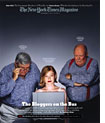 Matthew Klam's very long profile of (liberal) political bloggers in tomorrow's New York Times Magazine is great fun. (It will be on-line
 tonight already!; I'm reading the dead-tree version.) In a series of extended profiles of the superstars of the blogosphere, we learn that Josh Marshall's clothes "wrinkled at a faster rate than other people's"; that Ana Marie Cox never has to pay for dinner; that spilling 7-Up on Jesse Taylor's laptop is the way to his heart; that Markos Moulitsas of Daily Kos feels angst for making money blogging. But nothing in the story really surpasses the witty cover photo of the rotund Johnny Apple of the Times and Jack Germond of the Baltimore Sun reading over the tank-topped shoulders of Cox as she types on her laptop. Johnny Apple playing himself for laughs? How'd that happen?
Posted by Philocrites, September 25, 2004, at 12:43 PM | 1 comments
Thursday, September 23, 2004
Everything's coming up roses.
President Bush puts on his rosy goggles and says "life could be lousy, life could be OK, life could be better" over in Iraq. Juan Cole wonders, "If Iraq were America, what would it be like?" That doesn't sound too bad, does it?
Posted by Philocrites, September 23, 2004, at 06:42 PM | 0 comments
Gonna ban your Bible!
Here's the Republican National Committee's despicable "banned Bible" mailing, which is showing up not only in West Virginia but in Arkansas, too. Folks, liberals have been arguing that we, too, should be reading our Bibles — not banning yours. (Thanks, Tapped!)
Posted by Philocrites, September 23, 2004, at 06:32 PM | 1 comments
Beware 'Old Testament' comparisons.
I say this as a liberal who often can't fathom the allure of conservatism: Novelist Roland Merullo's op-ed in Monday's Boston Globe about America's fractured political culture was truly embarrassing. (Since I'm going to pick it apart here, you might want to read "A Puzzling America" first.) It starts off promisingly:
For a long time now I've been pondering the reasons why conservatives decide to be conservative and liberals to be liberal. Part of the motivation for this pondering is rooted in the fact that I'm a left-leaning independent with a number of conservative friends.
I thought — I hoped! — we might finally get to hear from someone still engaged in real dialogue across the dangerous partisan gulf that has opened in American civic life. But no. He immediately adds, "Some of these right-wing friends are close relatives, people I love dearly, people who still forward me nasty Internet jokes about Hillary and Bill with a certain kind of triumphant glee."
I don't doubt that Merullo has relatives and "friends" like this, but we can see right away that he's about to contrast a very specific sort of conservative (and a rather hostile sort of "friend") with a very idealized sort of liberal. My right-wing friends and relatives simply don't engage in odious behaviors like this — at least toward me — but, to be honest, a number of my liberal friends do. What bothers me in Merullo's essay is his refusal to acknowledge that liberals can hate right back, and that many conservatives don't dip into the gutter. I have all sorts of partisan reasons to think that my friends are better than my enemies, but it's no tribute to my critical thinking (much less my Christianity) if I rely on my prejudice and imagine my enemies only in their bad-guy role. Conservatives are people, too; I hope the ones who know me can think of at least one liberal they respect.
And then there's religion. Merullo starts by describing a reporting trip he took during the 1996 presidential election:
I drove from Bob Dole's birthplace (Russell, Kansas) to Bill Clinton's (Hope, Ark.) via Ross Perot's (Texarkana, Texas). I traveled back roads through small towns, stopping occasionally to ask people what word first came to mind when they heard the name "Clinton," "Dole," or "Perot."
Not surprisingly, the responses to "Dole" were more positive in Kansas than in Democratic eastern Oklahoma, and Clinton was better liked in Hope than in Russell. What did surprise me, though, were the kinds of things conservatives said about Clinton and the obvious hatred with which they said them: "Monster." "Nonhuman." "Worm." "Antichrist." "Devil."
I have no reason to doubt that people responded with such malice. But has he been to Cambridge, for example, since November 2000 and asked what words spring immediately to mind when someone says "Dick Cheney" or "George W. Bush"? Instead, he offers a theological explanation that he can't afford to explore fully:
That was the Bible Belt, where one might be more likely to hear the term "Antichrist," but the general pattern of vitriol held true in other parts of the country. I began to form the impression then that the conservative mindset springs from what, for lack of a better term, might best be described as an Old Testament world view: Life is harsh, God is angry, enemies ought to be treated without mercy. An eye for an eye. There is good and there is evil, and the distinction between them is as clear as the line between sin and righteousness. These days, the words of Rush Limbaugh, Bill O'Reilly, or George W. Bush only reinforce that impression.
I know we all grasp right away what he means by "Old Testament world view" — but that doesn't minimize the problems this phrase represents. For one thing, not to put too fine a point on it, it's tacitly anti-Semitic, rooted in a specifically Christian pattern of contrasting the harsh "Old" Testament with the loving "New" Testament.
The Christian Old Testament is, after all, the Jewish Bible. It's full of love and mercy and praise and wonder, mixed right in with vigorous depictions of war and sex and sacrifice. Denigrating Judaism by representing it as a primitive or unfinished precursor to the maturity of Christianity is one of the ways Christian theology and culture have nurtured anti-Semitism. Many branches of Western Christianity — including the Roman Catholic Church and several major branches of Protestantism — have formally abandoned "supercessionist" doctrines that portray Judaism in such a light. Relying on stereotypes with this sort of baggage, even when one is employing them innocently, taints one's argument.
So that's one problem. But Merullo's anxiety about religion in general seems to keep him from being explicit about the other half of his comparison. Conservatives are "Old Testament" meanies; liberals, on the other hand, are "New Testament" softies — but of course he can't bring himself to say so. Maybe he recognizes that claiming Jesus for the post-religious is going to be a hard sell. Maybe he has read Paul's epistles and knows that Christians didn't jettison judgment. So he simply moves on to a panegyric to the liberal appreciation of nuance.
The binariness of his column is simply breath-taking. I know there are deep, perhaps fundamentally unresolvable differences of worldview that make dialogue between some conservatives and some liberals impossible. So, sure, on one level I agree with Merullo that "The two Americas, conservative and liberal, worship two very different gods." But I'm convinced that many more of us can at least imagine and appreciate these differences; that many of us, liberal and conservative alike, believe we worship one God. (Or maybe I'm just a moderate.)
But I've saved the best for last. Behold! blind liberal self-aggrandizement:
At their essence, conservatives are on guard, bristling, armed with a righteous anger, prone to mockery of their enemies, sure of themselves, unwilling to criticize America, especially by comparing it to anyplace else. The attacks of Sept. 11 only confirmed their world view: We are constantly at risk.
Liberals are mannered, sensitive, armed with intellectual cynicism, self-critical, eager to learn from other cultures, wanting there to be no pain in the world. The attacks made them sad and angry, too, but their reflex was more pensive than vengeful.
If he were characterizing pundits, he'd be comparing apples to oranges. (Rush Limbaugh vs. Hendrik Hertzberg? What about Fareed Zakaria vs. Michael Moore?) But he's trying to explain the cultural differences between conservatives and liberals more broadly, and that's where his contrast seems off the rails.
If I'm related to more than four liberals on the entire Mormon side of my family — upwards of sixty first cousins! — I'd be amazed. (I think I know maybe a half-dozen conservative Democrats among them.) But Merullo's characterization doesn't fit them. They're conservative and deeply religious, too; we disagree on many things; but "bristling" and "prone to mockery" they're not. I respect them, and I think the ones who know me best respect me, too.
Meanwhile, living in Cambridge and knowing a very large number of Unitarian Universalists and various lefty folks, I can attest that not every liberal is "mannered," "self-critical," or "pensive." If only. Some of them entertain the most remarkable conspiracy theories you've ever heard.
I refuse to believe that most Americans have deliberately sequestered themselves in ideological ghettos. My guess is that most of us simply don't know how to start a conversation about political and worldview differences in a respectful way. We rely on stereotypes because more restrained conservatives and liberals are harder to spot in our churches or workplaces or neighborhoods than the crazies that make it onto the news. We're afraid of offending other people. On the left, too many of us think that all conservatives are "fundamentalists," a word that has become synonymous with evil in some so-called liberal minds. On the right, too many think that liberals are traitors, a debasement of the intellectual roots of American constitutional democracy — thanks, Ann Coulter! But we can do better than that. For the sake of our country, we must do better than that.
Posted by Philocrites, September 23, 2004, at 06:18 PM | 1 comments
Wednesday, September 22, 2004
U.S. Department of Irony Promotion.
Turns out it's not democracy that President Bush is promoting but a special case of what Keats called "negative capability." Here's Dan Froomkin on reactions to Bush's speech to the United Nations:
If the whole speech was a litmus test, this one sentence was the clincher:
"We know that dictators are quick to choose aggression, while free nations strive to resolve differences in peace," Bush said.
Some people see irony there. Others don't.
Those who don't see might consider taking their hands away from their eyes. Blind leading the blind, and all that.
But then I'm not sure what would help President Bush see what's happening in Iraq if he pays no attention to journalists and thinks his own intelligence agencies are "just guessing" when they say the three most plausible outcomes in Iraq are awful, even worse, or civil war.
Just for fun, let's pretend we're our president for a moment. First we hear from the "guessers" (aka our spies and professional intelligence analysts):
In a highly classified National Intelligence Estimate, the council looked at the political, economic and security situation in the war-torn country and determined that — at best — stability in Iraq would be tenuous, a U.S. official said late Wednesday, speaking on the condition of anonymity.
At worst, the official said, were "trend lines that would point to a civil war." The official said it "would be fair" to call the document "pessimistic."
But we're resolute and refuse to flip-flop, so we take this document with a Halliburton-size grain of salt and conclude that:
"The CIA laid out several scenarios that said life could be lousy, life could be OK, life could be better," Bush said. "And they were just guessing as to what the conditions might be like. The Iraqi citizens are defying the pessimistic predictions."
What an ironist! Let's translate Bush's worldview into everyday English:
- "Lousy" means "civil war."
- "Life could be OK" means cities under siege, increasing and widespread carnage, a paralyzed economy, regional instability, dozens of U.S. casualties every day. And, in the best-case scenario:
- "Life could be better" means daily suicide bombings, targeted killings of middle-class professionals and police trainees, beheaded U.S. workers, and no economic development or infrastructure work by the U.S.
Everything's coming up roses!
Posted by Philocrites, September 22, 2004, at 06:06 PM | 0 comments
Sunday, September 19, 2004
With steadfast, resolute victories like these...
Thank God a few Republican senators are willing to break with the official Bush administration fantasy that we're making tremendous progress on bringing democracy to Iraq. Among them:
Sen. Chuck Hagel (R-Neb.): "No, I don't think we're winning. We're in trouble, we're in deep trouble in Iraq." (CBS "Face the Nation")
Sen. Richard Lugar (R-Ind.), on why only $1 billion of $18 billion appropriated last year for Iraqi reconstruction had been spent: "Well, this is the incompetence in the administration." (ABC "This Week")
The two members of the Senate Foreign Relations Committee also scolded the Bush administration sharply last week:
The Senate Foreign Relations Committee heard testimony from State Department officials seeking to divert almost 20 percent of the $18.4 billion in US reconstruction funds to security operations instead of public works projects and economic development.
But the hearing quickly became a forum for attacking what the Republican committee chairman, Senator Richard G. Lugar of Indiana, referred to as the "dancing-in-the-street crowd" that wrongly predicted that Iraqis would be celebrating after the fall of Saddam Hussein a year and a half ago. He said the same White House officials have repeatedly failed to make necessary course changes.
"Now, the nonsense of all [the predictions] is apparent; the lack of planning is apparent," he said.
Senator Chuck Hagel, Republican of Nebraska, addressing two of the State Department's point men on Iraq, said the pace of reconstruction has been "beyond pitiful. It's embarrassing. It is now in the zone of dangerous."
"You don't win the hearts and minds of the people at the end of a barrel of a gun," Hagel, a Vietnam War veteran, said. "You do that through the process that we started here in the Congress appropriating $18.4 billion."
As for the original architects of the Iraq war, he added: "Maybe we ought to have a hearing with the inventors of this, have them come back up, all these smart guys that got us in there and said, 'Don't worry.' "
("GOP senators voice rising concerns on Iraq," Brian Knowlton [International Herald Tribune], New York Times 9.19.04, reg req'd; "Two GOP leaders attack Iraq policy," Brian Bender, Boston Globe 9.16.04)
Posted by Philocrites, September 19, 2004, at 11:12 PM | 0 comments
Methodist bishop condemns RNC 'Bible ban' mailing.
Chuck Currie posts a message from a United Methodist bishop in West Virginia condemning the Republican National Committee mailing to voters in his state that claims liberals want to ban the Bible.
Posted by Philocrites, September 19, 2004, at 07:47 PM | 0 comments
Saturday, September 18, 2004
Credo, a first draft.
Here's something I've been meaning to reflect on for some time: A statement of faith I wrote as a college student back in June 1993, when I had been attending the First Unitarian Church in Salt Lake for two years. (I can't quite remember the context, although I think I had written it for one of our young adult group meetings because I have a clear memory of discussing it with people in the young adult group in Fault Line Park on 400 South. It's a wonderful memory of the way the midsummer sky looks over the city a little before sunset.) Later, I'll also post a statement I presented more recently at the UUA General Assembly in Quebec City on Christian humanism.
My goal in posting these two statements is to reflect on some of the religious themes that are strongly present or notably absent — or sublimated! — in each statement, because I've been aware for a long time that some of the religious ideas I feel drawn to are in some tension with the more personal affirmations that I've found a way to make, and I've never quite known how to address that tension. But I'll save the rest of my commentary for later. Here's the "Credo" I wrote when I was 22:
I am a human being, responsible to the world of time and things to cultivate meaning in and by my life.
I am a human being, surprised to be alive; I am a human being, stunned that I will die. My responsibility grows from the awareness that I did not choose to be born, and that I did not choose to die. My responsibility is to cultivate creative and healing places in the plot fenced between my birth and my death.
I am broken and I am whole. I know regret and grief, and I know hope, and I know joy. I do not need salvation, nor the curse of damnation: I am always saved and damned, dependent and free, benevolent and evil. I am no dualist; I am a human being. I am alive with the hope that wholeness lives in brokenness.
I know what it is to be grabbed at the core by another personality. I know what it is to fall under the spell — for good and evil — of a hero, of a parent, of a lover. I know what it is to run from the challenge of loving. I know how impossible and still necessary it is to love the world. I know that the inevitability of loss — death in all its many forms — gives strength to love and makes love terrible and wonderful to inhabit.
I know that no one has ever been right before, that every prophet, saint, witch, philosopher, parent, book — that every one has been both true and not true, that truth is not, in its most important sense, a finished product but the activity that continues in the midst of being wrong and being unhappy to be wrong.
I am a human being, and the need to speak as a human being — and not as a member of some smaller group with its insiders and its outsiders — is at the essence of the impulse toward true religion. To be bound together, to be religious, is to feel and express the true interconnection of things. This is an impossible stance; this is the only possible way to be. Being is what it is I would become. "I am a human being; nothing human is alien to me."
First, yes, I do see myself being clever and deliberately paradoxical and I'm just a bit embarrassed about that, but what can you do? This is what I really wrote when I was 22.
But on to substance. I have always felt the most ambivalence about my statement "I do not need salvation, nor the curse of damnation," because even as I wrote this statement I knew I was overstating my own view. I had read and found great insight in William James's Pragmatism, and strongly marked this passage in the final chapter:
May not the claims of tender-mindedness go too far? May not the notion of a world already saved in toto anyhow, be too saccharine to stand? May not religious optimism be too idyllic? Must all be saved? Is no price to be paid in the work of salvation? Is the last word sweet? Is all 'yes, yes' in the universe? Doesn't the fact of 'no' stand at the very core of life? Doesn't the very 'seriousness' that we attribute to life mean that ineluctable noes and losses form a part of it, that there are genuine sacrifices somewhere, and that something permanently drastic and bitter always remains at the bottom of its cup?
I've never shaken off the tragic sense I acquired when, in the lingo of my Mormon childhood, I "lost my testimony" of the Mormon "plan of salvation." So James's acknowledgment of ineluctable loss rings very true to me. But the ghost in what I go on to say — "I am alive with the hope that wholeness lives in brokenness" — remains at the heart of my faith today. The most powerful fact in the devastating experience of losing my Mormon faith as a freshman in college was my sense that I was freed from great mental and spiritual anguish. (I can even point to the moment when it happened.) And although my immediate response to that moment of liberation was to stop praying to a God I feared, the strange thing was that I now had an experience that I recognized as a kind of grace.
That paradox — that I do believe we experience both salvation and damnation even though in my credo I claim not to need the promise of one or the fear of the other — is probably the central puzzle of my liberal faith today. It's also at the heart of my attempts to wrestle with the meaning of the Christian story of resurrection, which I've always responded to strongly even though I have often not felt able to "believe in" it. (You can read an essay I wrote about resurrection back in 1996 here.) When I was actively writing new hymn texts as part of my senior thesis at Harvard Divinity School, I wrote a compressed stanza about my idea of grace that goes like this:
My soul is held and, turning, is returned
By love unseen, a gravity sublime.
Though light had failed, as my heart in its time,
Your dawn, O God, has graced my life unearned.
Hard to sing, I admit, but at times that really has been my experience.
There are other things I notice in my eleven-year-old credo, but I think I'll save further reflection for later posts. You're welcome to comment or respond to it, too.
Posted by Philocrites, September 18, 2004, at 09:37 AM | 2 comments
Friday, September 17, 2004
Best-kept secret in Christianity.
Yes, Virginia, there is such a thing as a "liberal Christian" — and here's a Web site that collects the evidence. (And of course I appreciate the link to Philocrites!)
Posted by Philocrites, September 17, 2004, at 05:13 PM | 0 comments
Hurricanes' impact on Unitarian Universalists.
The UUA Web site today includes information about the widespread impact of hurricanes Frances, Ivan, and Charley on Unitarian Universalist congregations in Florida. The properties of the 73-member Friendship Fellowship at Pineda near the Indian River in Rockledge were destroyed, and several other church buildings throughout the state have been damaged. More immediately devastating are the destroyed, flooded, and battered homes of many UUs and their neighbors. (There are 43 Unitarian Universalist congregations in Florida, with 5,128 adult members and 1,032 children enrolled in religious education.) Sadly, one member of the UU Fellowship of Charlotte County died in hurricane Charley.
Disaster relief for the Florida District of the UUA may be sent — with "Disaster Relief Fund" in the memo line of your check — to:
Florida District-UUA
1901 E. Robinson St. #18
Orlando FL 32803
The UUA Web site also includes some information about the impact of Charley on Unitarian Universalists in the Mid-South District.
Posted by Philocrites, September 17, 2004, at 05:04 PM | 0 comments
Wednesday, September 15, 2004
Woe is me! Whew!
Update 9.22.04: Thanks to Jay Allen and MacManX, I've fixed the spam blacklist and once again shut the gates on levitra peddlers and Texas hold-em barkers.
Posted by Philocrites, September 15, 2004, at 10:50 PM
Tuesday, September 14, 2004
Recommended reading.
That's all I have time to comment on this week, but here's more you'll want to ponder:
- "How Bush Speaks in Religious Code," Bruce Lincoln, Boston Globe 9.11.04
- "Openly Religious, to a Point: Bush Leaves the Specifics of His Faith to Speculation," Alan Cooperman, Washington Post 9.16.04, reg req'd; see also "Words of God," Ayelish McGarvey, Tapped 9.16.04
- "The Bush Crusade," James Carroll, The Nation 9.20.04
And, stepping off the Bush theme for a moment but staying with James Carroll, I'd especially recommend Carroll's op-ed this morning in praise of Benedict Spinoza, "America's Jewish Founding Father," a wonderful tribute to a religious and political liberal.
Posted by Philocrites, September 14, 2004, at 07:41 PM | 0 comments
Resisting stem cell utopianism.
I get the Christian Century in the mail at least a week before it goes on-line, and I've been waiting for the chance to alert you to the excellent editorial in the September 7 issue responding to Ron Reagan's address at the Democratic National Convention.
(The editorial is on-line now, but the magazine doesn't seem to generate permalinks, so the next issue's editorial will replace this one soon. If you read this post after the article vanishes from the Web, head to your library and read "Stem Cell Rhetoric," Sept. 7, 2004, Vol. 121 No. 18, page 5.)
The editors of the liberal Protestant magazine say Reagan's speech was a "textbook example" of how to "marginalize religion and trivialize moral argument," which may account for the discontent I felt watching Reagan. The editors write:
He granted that some people have moral objections to cloning human embryos for the sake of extracting stem cells (which leads to the destruction of the embryos). He allowed that such people are “well-meaning and sincere,” and are “entitled” to their belief that human embryos have moral value and should not be created and destroyed for others’ use. “But it does not follow that the theology of a few should be allowed to forestall the health and well-being of the many,” he contended. To proceed with research is to be on the side of “reason” as opposed to “ignorance,” he went on, and such pursuit of knowledge is part of an inevitable movement toward human enlightenment: “The tide of history is with us.”
Reagan deftly makes several familiar moves. First, he relegates strong moral beliefs to the private sphere—one is “entitled” to have such beliefs, but to argue for them in public is to force them on “the many” who don’t share them. At the same time, he labels the moral claim that he disagrees with a “theology,” thereby both eliminating the need to argue with it (since presumably it is beyond rational discussion) and insinuating that those who press such a claim are guilty of religious coercion. He then aligns his position with “reason” and “progress”—opponents, naturally, of theology.
To see what is wrong with this argument, try substituting “infanticide” or “slavery” for “stem cell research.” As in: “Those who believe infanticide is wrong are entitled to their belief, but their theology should not forestall the well-being of the larger society or the movement of history toward enlightenment.” Or: “Those calling for the abolition of slavery are no doubt sincere, but they shouldn’t impose that belief on the rest of us.” The logic of the argument is the same.
The editorial concludes that we can't simply skip past the moral dilemmas of this new branch of medical technology: "Scientists’ ability to create and destroy embryos for research and therapeutic purposes presents a specific moral challenge to the valuing of human life. To deliberately create, use and discard embryos for the sake of curing disease is to adopt, in an unprecedented way, a utilitarian view of human life."
How do Unitarian Universalists, who "covenant to affirm and promote the inherent dignity and worth of every person," respond to the moral issues in stem cell research? Do they — do we, in our embrace of science — simply adopt a utilitarian view of human life?
I find some tension between two basic argments in UUA President Bill Sinkford's statement on stem cell research, which he issued back in November 2001. On the one hand, he argues that "no human embryos should be created specifically for stem cell experimentation, thus turning human life and human reproduction into a commodity — surely a clear affront to our first principle affirming the inherent dignity of human beings," a statement I emphatically endorse and which steps back from a strictly utilitarian approach. On the other hand, Sinkford also says: "Because I do not consider human embryos to be people, and because Unitarian Universalists insist that reproduction is a personal and private matter, I believe that there should be no ban on embryonic stem cell research."
The two sentences don't completely contradict each other: As long as embryonic stem cell research does not involve embryos created for research purposes, one can argue that they weren't created as commodities. But the moral issue, as Sinkford notes, is that we do regard embryos in human terms, even if we do not regard them "as people." But I don't think Unitarian Universalists — or many other people, for that matter — have a clear or simple way to proceed here. How do we assess the human dignity of the nascently human?
I've attended a funeral for a still-born child and know how deeply people can grieve a miscarriage, so I don't buy the idea that a fetus is "just a fetus." But I also reject what I see as the false clarity of those who would make all abortions illegal on the grounds that a zygote is a human being. Most people do behave as if they recognize gradations of humanity, as it were, between the very first stages of a pregnancy — when we might think it was a bit strange to hold a funeral for a zygote that didn't survive — and the late stages — when most of us clearly do respond to a fetus as a child and regard it as having its own health and even its own personality, and immediately sympathize with a mother's grief for a miscarriage. But few of us could easily say when a pregnancy moves from one stage to the next. It seems to me that's what makes the issue morally difficult and inevitably political.
I'm not entirely sure how to approach the ethics of embyonic stem cell research — other forms of stem cell research seem less morally problematic — but I do strongly suspect that a combination of biomedical dollars and utopian wishfulness will put a lot of pressure on the utilitarian lever of our public ethics. The commodification of human life will intensify. Could some good come of stem cell research? Way down the road, probably. Having watched one grandfather suffer intensely from Parkinson's Disease and another fade into the strange fog of Alzheimer's, I can appreciate the perfected world Ron Reagan wants to usher us into, but I can't shake off my reservations. For me, affirming the inherent dignity and worth of each individual can't simply serve as a moral principle once the umbilical cord is cut; some version of the principle should inform our moral thinking about nascent human life, too, even if one also recognizes (as I do) the tragic necessity of legal abortion.
Anyway, Ron Reagan's speech didn't convince me — and I appreciated the Christian Century's editorial. Maybe you can help me refine my thinking on the subject.
Posted by Philocrites, September 14, 2004, at 06:39 PM | 1 comments
Monday, September 13, 2004
Whaddya know? I'm undecided!
Mrs Philocrites and I are voting in the Democratic primary for our local representative tomorrow — and we're still undecided! Do we vote for the unglamorous, conservative incumbent Tim Toomey, whom I've found very responsive to our neighborhood group and who bucked Speaker Tom Finneran's anti-gay marriage amendment plans earlier this year, or 30-year-old progressive up-and-comer Avi Green, who has set lefty hearts a-racing? I'll know tomorrow!
Here's the media coverage that's helping us make up our minds:
Update 9.14.04: I decided that Toomey would still be an effective advocate for my Inman Square neighborhood in his other job on the Cambridge City Council, that his votes on the gay marriage amendment seemed a bit anomalous given his Catholic defense of his anti-abortion votes, and that electing Avi Green — who ran Jarrett Barrios's 1998 campaign — could hardly be construed as voter rebellion against Toomey's amendment votes. So I voted for change.
Posted by Philocrites, September 13, 2004, at 11:05 PM | 1 comments
Saturday, September 11, 2004
Fonts in the news, indeed.
For once, our "Fonts in the News" feature isn't a diversion but takes us right into the middle of the presidential election coverage. So what do typographers think of the CBS documents? (I'm suspicious of the presence of a 'smart' apostrophe in a typed document. I also think it's much more in the interests of pro-Bush people to generate forgeries in this case than pro-Kerry people.)
Update 9.12.04: See also The Shape of Days for fascinating samples from an IBM Selectric Composer, circa 1973, and Microsoft Word, circa 2004.
Posted by Philocrites, September 11, 2004, at 09:02 AM | 2 comments
Friday, September 10, 2004
Jesus: Massachusetts liberal.
Mad Magazine offers this parody of a Bush/Cheney ad. Imagine what the campaign would say if Jesus were running against them . . . Have a great weekend!
Posted by Philocrites, September 10, 2004, at 06:09 PM | 0 comments
Meet your fellow Philocritics, part 2.
I'm enjoying hearing from people who read this site — thanks to everyone who participated in the first poll of Philocrites-readers! — and I'm interested in learning how you use it. So, without further ado, on to the second poll:
Posted by Philocrites, September 10, 2004, at 05:58 PM | 3 comments
The unpenitent incompetent.
Tom Schade at Prophet Motive writes:
George W. Bush['s] perceived character is his greatest political strength. He is, he and his campaign repeatedly tell us, a good man: uncomplicated, resolute, morally clear by instinct, determined, straightforward, born-again after an irresponsible youth.
None of this is actually true.
Tom's eloquent analysis of the president's dishonesty, unprincipled stubbornness, and false populism is definitely worth reading. Here's the section that specifically addresses Bush's religiosity:
And finally, George Bush is not born-again, but is, in religious terms, unrepentant. His religious convictions are self-serving window dressing and self-advertisement. His faith, and mine, tells me that men and women who have sinned are forgiven by the grace of God. One can be born-again. It is true that the relationship between one’s repentance and God’s forgiveness is never clear from the outside. But the fruit by which one can tell a born-again soul is its repentant and humble spirit. The state of the soul is revealed in the character of the person. Nothing spoke more clearly about the state of George Bush’s character, and soul, than his stunning unwillingness to describe a single error that he has made. Nothing tells us more about him than his seeming allergy to the dead US soldiers and Marines in Iraq. He will associate himself in public with the wounded, brave and recovering as they are, but never with the dead. It is same character of a man who will stop drinking, but never describe himself as an alcoholic, and never do the fearless moral inventory that recovery seems to require.
Meanwhile, on the same subject but coming at it from a political rather than moral theological angle, Matthew Yglesias writes in The American Prospect:
Reviewing Clinton’s My Life in the June 24, 2004, Los Angeles Times, neoconservative Max Boot happily concluded that “conservatives like character, liberals like cleverness.” He’s right. But to state what should be obvious, the president is not your father, your husband, your drinking buddy, or your minister. These are important roles, but they are not the president’s. He has a job to do, and it’s a difficult one, involving a wide array of complicated issues. His responsibility to manage these issues is a public one, and the capacity to do so in a competent and moral manner is fundamentally unrelated to the private virtues of family, friendship, fidelity, charity, compassion, and all the rest.
For the president to lead an exemplary personal life is surely superior to the alternative. But within obvious limits — no one would want an alcoholic president, for example — it doesn’t really matter. Clinton’s indiscretions caused his family pain and produced awkward moments for the parents of some young children. But Bush’s bungling has gotten people killed in Iraq, saddled the nation with enormous debts, and created long-term security problems with which the country has not yet begun to grapple.
That the country should be secured against terrorist attacks, that deadly weapons should be kept out of the hands of our enemies, or that it would be good for a wide slice of the world to enjoy the blessings of freedom and democracy are hardly controversial propositions. But these things are easier said than done. Even a person of goodwill is by no means guaranteed to succeed. Yet succeed we must. And if we are to do so, the question of intelligence must be put back on the table. The issue is not “cleverness” — some kind of parlor trick or showy mastery of trivia — but a basic ability to make sense of a complicated, fast-changing world and decide how to confront it.
("The Brains Thing," Matthew Yglesias, The American Prospect 9.1.04)
Posted by Philocrites, September 10, 2004, at 05:28 PM | 0 comments
Thursday, September 9, 2004
Forrest Church on church and state.
On Point, WBUR's evening public affairs program, will feature the Rev. Dr. Forrest Church tonight. Church is minister of one of the Unitarian Universalist Association's most prominent churches, All Souls in New York City, and author of many books — including The Separation of Church and State: Writings on a Fundamental Freedom by America's Founders. (Check On Point's Web site tomorrow for streaming audio of the program.)
Posted by Philocrites, September 9, 2004, at 05:43 PM | 0 comments
What insiders say the insiders are saying.
The Campaign Desk at the Columbia Journalism Review keeps an eye on the campaign coverage for you — including the "insider's bible" of political journalism, the super-expensive National Journal. And what are the insiders saying about the polls and the trends in this year's presidential election? Steve Lovelady describes the analysis of Charlie Cook, National Journal's pollster:
Cook writes that Clinton White House political director Doug Sosnick has determined that in the four most recent presidential re-election campaigns (Carter, Reagan, Bush Sr. and Clinton) the incumbent's job-approval ratings were showing clear and unambiguous by June, at which point the public had its mind made up about whether to re-elect the incumbent. If that theory holds up ... President Bush's 48 percent approval rating (the number has not wavered since March) will not be enough to win re-election in a two-way race and may not be enough to win even in a three-way race.
Polls suggest that Americans have come to see the war with Iraq and U.S. policies in the Mideast as inadvertently increasing the threat of terrorism in the United States. ...
[Democrats] will gain little by attacking Bush's character. Among swing voters, there is a real openness to attacks on Bush's decisions and priorities. Attacks on Bush's character, however, can backfire and shift undecided voters to his side .... Bush's re-election is in extreme dangers because of the decisions, priorities and actions of his administration, not because of strategic or tacticial missteps made at the Bush-Cheney '04 headquarters in Arlington, Va. ...
Offsetting that,
Some observers think that if Kerry had as much personality as most ashtrays, he would have been ahead by 10 points even before picking Edwards or holding his national convention. Although that assessment is probably a bit harsh, Kerry has had trouble connecting with voters on a personal and emotional level. ...
[A] simple test tells us a lot about how this race may unfold in the coming months. Ask yourself how many people you know who voted for Gore in 2000 but who are planning to vote for Bush this year. Then ask yourself how many Bush 2000 voters are planning to vote for Kerry. Outside of the pro-Israel community, there are very, very few Gore voters who appear likely to defect to Bush. But most people can name Bush voters who appear ready to switch their allegiance to Kerry. ...
Voters in 10 states, led by Ohio, Pennsylvania and Florida, in that order, says Cook, will determinte the outcome of the election. Filling out the list of make-or-break states are Iowa, Missouri, Minnesota and Wisconsin in the Midwest, Nevada and New Mexico in the Southwest, and little ol' New Hampshire, which, Cook says, just might at long last "get to play a real role in a general election."
There you have it. Mrs Philocrites and I are likely to take a few days sometime before the election to volunteer in Ohio or Pennsylvania. You can, too. Meanwhile, bite your nails daily at the visually gripping Electoral Vote Predictor. I sure do. (Thanks for the tip, Rebecca!)
Posted by Philocrites, September 9, 2004, at 05:28 PM | 0 comments
Beacon Press's blog.
 Beacon Press, the well-respected independent book publishing company owned by the Unitarian Universalist Association, has launched a blog featuring a number of its writers: Beacon Press Authors on the Issues. Contributors include folklorist Carol Burke, economist Ellen Frank, journalism professor Ben Bagdikian, and the Rev. Forrest Church. Check it out!
Posted by Philocrites, September 9, 2004, at 05:01 PM | 1 comments
Tuesday, September 7, 2004
Why Bush deserves to lose.
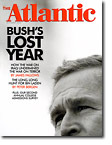 You can read the cover of next month's Atlantic Monthly if you'd like the sound-bite version, or you can read the magazine's Table of Contents if you'd like it just a bit longer: "By deciding to invade Iraq, the Bush Administration decided not to do many other things: not to reconstruct Afghanistan, not to deal with the threats posed by North Korea and Iran, and not to wage an effective war on terror." (That sums up what the entire Republican National Convention tried to whitewash.) Or you can read James Fallows's full report: "Bush's Lost Year."
Posted by Philocrites, September 7, 2004, at 05:42 PM | 0 comments
Monday, September 6, 2004
The oracle at Fenway.
I haven't been especially vigilant at the Red Sox Theology Watch this season, but as the team's fortunes have taken a definite turn for the better since Nomar's departure, well, sooth-saying has come back strong. Naturally, it's all focused on "reversing the curse," the enduring focus of much New England faith, er, superstition.
Let's see: We have the 1918 penny left by a patron at a Fenway Park beerstand:
[I]ts meaning is undeniable, [the bartenders] say: Every fan knows 1918 was the last year the Sox won the World Series, the year before George Herman ''Babe" Ruth was sold to the evil Yankees, reputedly unleashing the legendary Curse of the Bambino. . . .
The good-luck penny is now taped to the stand's beer fridge, where the men plan to display it for the rest of the season. ''If you're a Red Sox fan and you've been around for this long, you get it."
And there's the serendipitous constellation of omens last week, when a foul ball bloodied a teenage boy — you know, a blood sacrifice on the Fenway altar. Is wasn't just any teenage boy, either:
[O]n a night when the moon was nearly full, when the Sox continued their epic surge, and when the Yankees suffered the most lopsided defeat in the history of the storied franchise, [Manny] Ramirez may have unwittingly done what countless others have failed to do before him. He may well have broken the curse under which the team has labored since Ruth was sold to the Yankees in 1919.
A 16-year-old boy stood up in Section 9, Box 95, Row AA, with hopes of catching the ball. But he wasn't just any teenager. No, this was Lee Gavin, who has lived his entire life in a rambling farmhouse on Dutton Road in Sudbury that is best known to anyone west of Boston as the house where Babe Ruth lived.
Mrs Philocrites says she expects to hear soon about the entrails of buffalo wings. Keep your fingers crossed and avoid black cats on Yawkey Way: This could be the year.
Posted by Philocrites, September 6, 2004, at 10:30 AM | 1 comments
Sunday, September 5, 2004
The gimme society.
What exactly would an "ownership society" — the name President Bush gives to his domestic policy ideals — look like? And why are you haunted by the sense that a domestic agenda focused on health savings accounts, "privatized" Social Security, and tax cuts on investments will end up hurting a lot more people than they'll help?
Jonathan Chait explains in "Up and Away: Bush's Schemes to Fleece the Poor" in the New Republic (happily available to non-subscribers!). Chait identifies the fundamental problem with health savings accounts (HSAs):
Insurance is supposed to spread risk: Rather than a few people (the very sick) losing everything and most people (the healthy) getting off scot-free, everybody pays a little bit. That's what company health plans do. But HSAs would encourage the well-off and the healthy to pull out of group plans; the more that do so, the higher the rates rise for the sicker folks remaining, leading more people to drop out. That's the vicious cycle that has driven up both insurance costs and the number of uninsured. Bush's plan would accelerate it.
He explains that "Social Security is another form of insurance—insurance against the risk of making bad investments, the risk of outliving your savings, the risk that a disability keeps you from working, or the risk of being widowed." But President Bush wants to transform Social Security radically:
Bush insists that workers "need to own and manage their own pension and retirement systems." He proposes that, instead of giving your payroll taxes to support somebody else's retirement, you should be able to keep some of it for yourself. Unfortunately, there is an arithmetic problem with that idea. Right now, payroll taxes go to fund people who are currently retired. If that money were instead diverted into the individual accounts of those still in the workforce, it would open up a huge financing hole (at least $1 trillion over a decade). And remember, Social Security is already facing a financing hole as it is.
Beyond the shaky math, there's a deeper philosophical principle at stake. If you control your own retirement, you have a better chance of striking it rich in the stock market. But you also have a better chance of losing your money.
My question, on top of those Chait addresses, is this: What exactly is the Republican plan for dealing with people who lose their privatized Social Security funds through poor investing? (Oops! Too much Enron stock. I guess that's it for me!) Do we simply allow unfortunate investors to wallow in poverty? That's not going to work out well.
Chait also explains how Bush's tax reform proposals would make wealthy people unbelievably richer without helping the rest of us. Those of us who live by our wages would continue to be taxed, of course, and low-income Americans who don't pay income tax but who do pay Social Security taxes and regressive sales taxes would also keep right on paying large portions to the government, but the wealthy — who live more by investment income than by their paychecks — would pay less and less the more they depend on non-wage income like investments, inheritance, and interest.
Sounds like the "gimme society" to me.
Posted by Philocrites, September 5, 2004, at 09:19 PM | 0 comments
Filling an empty space.
Hoboken, N.J., suffered more deaths on 9/11 than any other city outside New York. A support group for survivors and relatives at Hoboken's Trinity Episcopal Church is starting to "move on," but the members of the group are giving a thank-you gift to the church:
In the church's steeple, about 40 feet from the ground, above the black stone and red trim, was a 28-inch-wide bell cove without a bell. There was, it turned out, an empty space in the church, as intimate as their grief had been vast. Why not fill the space? Why not give the church a bell?
("A lasting gift, from a terrific club that nobody wanted to join," Peter Applebome, New York Times 9.5.04, reg req'd)
Posted by Philocrites, September 5, 2004, at 10:26 AM | 0 comments
Poor, struggling drug companies.
 The former editor of the New England Journal of Medicine, Marcia Angell, has written a book titled The Truth About the Drug Companies: How They Deceive Us and What To Do About It. Carl Elliott, in his review for the Boston Globe, notes:
For many years the drug industry has reaped the highest profit margins of any industry in America. In 2002, the top 10 American drug companies had profit margins of 17 percent; Pfizer, the largest, had profit margins of 26 percent. So staggeringly profitable is the drug industry that in 2002 the combined profits for the top 10 drug companies in the Fortune 500 were greater than those of all the other 490 companies combined.
Meanwhile, Elliott writes, these extraordinarily profitable corporations are selling us a bill of goods:
How does the drug industry deceive us? Let us count the ways. It deploys an army of 88,000 sales representatives to stalk the hallways of clinics and hospitals, bribing doctors with food and trinkets to listen to sales pitches. It plies attending physicians with expense-paid junkets to St. Croix and Key West, Fla., where they are given honoraria and consulting fees to listen to promotional presentations. It pays doctors to allow salespeople disguised as ''preceptors" to shadow them in clinics and watch them examine unsuspecting patients. It promotes new or little-known diseases such as ''social anxiety disorder" and ''premenstrual dysphoric disorder" as a way of selling the drugs that treat them. It sets up phony front groups disguised as ''patient advocacy organizations." It hires ghostwriters to produce misleading scientific articles and then pays academic physicians to sign on as authors. It sends paid lackeys and shills out onto the academic lecture circuit to ''educate" doctors about a drug's unapproved uses. It hires multinational PR firms to trumpet dubious studies as scientific breakthroughs while burying the studies that are likely to harm sales. It controls the mind of medical America by paying for 60 percent of continuing medical education, in part by laundering the money through for-profit ''medical education and communications" companies. It buys up the results of publicly funded research, claims exclusive marketing rights, and then charges the public vast sums to buy back what its tax dollars have produced. It maintains a political chokehold on the American public by donating more money to political campaigns than any other industry in the country.
Outrageous. ("A dangerous dose," Carl Elliott, Boston Globe 9.5.04)
Posted by Philocrites, September 5, 2004, at 10:10 AM | 0 comments
Saturday, September 4, 2004
Distracted by the 'God gap.'
An important reminder from two prominent sociologists of religion about President Bush's real political base:
[T]he fashionable image of masses of white evangelical voters, stirred up by the tricks of Karl Rove and led by Bible-thumping clergymen, marching in lock step to deny rights to women and to gays, is hardly born out by the data. Rather, the real Republican base is the same as it was before Richard Nixon's "Southern strategy" appealed to religious Protestants in 1968: the wealthy and the powerful. . . .
One-fifth of white Americans who belong to "fundamentalist" churches (like Southern Baptist, Assembly of God, Holiness, Pentecostal and Missouri Synod Lutheran) are remarkably pluralistic in their political and social attitudes. While it is true that white evangelicals tend to be more conservative socially, as well as religiously, than the average American, there is little correlation between religious conservatism and political conservatism. . . .
In fact, polling data show that President Bush's real base is not religious but economic, the group he jokingly referred to as "the haves and the have mores." . . .
If the Republicans were to lose their 18-point advantage among the affluent, it would cost them about four percentage points nationwide in the election, more than twice the cost if they were to lose their edge among evangelicals.
Make sure the read the rest. ("A Hidden Swing Vote: Evangelicals," Michael Hout and Andrew M. Greeley, New York Times 9.4.04, reg req'd)
Posted by Philocrites, September 4, 2004, at 10:28 PM | 0 comments
Friday, September 3, 2004
Good news from 'The Christian Century.'
At last, The Christian Century has significantly upgraded its Web site and now publishes much more of the magazine on-line. I've noticed some real improvements in the magazine over the last year or two — especially the short and often off-beat "Century Marks" that follow the editorial. Unfortunately, it's not easy to find in bookstores or on magazine stands, but your public or university library ought to be a subscriber. The magazine's motto — "Thinking Critically, Living Faithfully" — perfectly captures what I mean by critical faith. It's one of my favorite magazines.
Posted by Philocrites, September 3, 2004, at 05:25 PM | 0 comments
Thou shalt not lie, et cetera.
The Associated Press observes that "Bush Glosses over Complex Facts in Speech." Not just complex facts, either. We're talking really important facts:
On Iraq, Bush derided Kerry for devaluing the alliance that drove out Saddam Hussein and is trying to rebuild the country. "Our allies also know the historic importance of our work," Bush said. "About 40 nations stand beside us in Afghanistan, and some 30 in Iraq."
But the United States has more than five times the number of troops in Iraq than all the other countries put together. And, with 976 killed, Americans have suffered nearly eight times more deaths than the other allies combined.
Bush aggressively defended progress in Afghanistan, too. "Today, the government of a free Afghanistan is fighting terror, Pakistan is capturing terrorist leaders ... and more than three-quarters of al-Qaida's key members and associates have been detained or killed. We have led, many have joined, and America and the world are safer."
Nowhere did Bush mention bin Laden, nor did he account for the replacement of killed and captured al al-Qaida leaders by others.
He attacked Kerry for voting against an $87 billion package for Iraq and Afghanistan operations that included money for extra sets of body armor and other supplies, mocking his opponent for saying the issue was complicated. "There's nothing complicated about supporting our troops in combat," Bush said.
But the bill in question was not solely about supporting troops and Kerry's campaign said he ultimately voted against it because, among other reasons, it included no-bid contracts for companies.
Kathleen Hall Jamieson, who tracks the accuracy of campaign rhetoric at the University of Pennsylvania's Annenberg School for Communication, said Bush overstepped on a few claims about Kerry.
"The speech distorts Kerry's positions by suggesting that he opposed Medicare reform when he instead favored an alternative, and opposed tax cuts for all when he in fact supported the middle class cuts and opposed cuts for those making more than $200,000," she said.
(Thanks, Kos!)
Or bear false witness.
The Washington Post says "GOP Prism Distorts Some Kerry Positions" — such as:
- Kerry did not cast a series of votes against individual weapons systems, as Sen. Zell Miller (D-Ga.) suggested in a slashing convention speech in New York late Wednesday, but instead Kerry voted against a Pentagon spending package in 1990 as part of deliberations over restructuring and downsizing the military in the post-Cold War era.
- Both Vice President Cheney and Miller have said that Kerry would like to see U.S. troops deployed only at the direction of the United Nations, with Cheney noting that the remark had been made at the start of Kerry's political career. This refers to a statement made nearly 35 years ago, when Kerry gave an interview to the Harvard Crimson, 10 months after he had returned from the Vietnam War angry and disillusioned by his experiences there. (President Bush at the time was in the Air National Guard, about to earn his wings.)
- President Bush, Cheney and Miller faulted Kerry for voting against body armor for troops in Iraq. But much of the funding for body armor was added to the bill by House Democrats, not the administration, and Kerry's vote against the entire bill was rooted in a dispute with the administration over how to pay for $20 billion earmarked for reconstruction of Iraq.
And then there's this bit of complex fact:
While Cheney said Kerry opposed Reagan's "major defense initiatives," the campaign does not cite any votes against such defense programs while Reagan was president, relying instead on a campaign speech before he was elected senator.
Six years later, Kerry took part in a complex and serious debate in Congress over how to restructure the military after the Cold War.
Cheney, at the time defense secretary, had scolded Congress for keeping alive such programs as the F-14 and F-16 jet fighters that he wanted to eliminate. Miller said in his speech that Kerry had foolishly opposed both the weapons systems and would have left the military armed with "spitballs." During that same debate, President George H.W. Bush, the current president's father, proposed shutting down production of the B-2 bomber — another weapons system cited by Miller — and pledged to cut defense spending by 30 percent in eight years.
That's right, folks: Senator Kerry was so far to the left he actually agreed with known leftists George H.W. Bush and Dick Cheney. (Glenn Kessler and Dan Morgan, Washington Post 9.3.04, reg req'd; thanks, Nick Confessore!)
Honor thy father and mother.
And finally: Did you notice what George W. Bush seems to go out of his way not to acknowledge about his own family?
I am grateful to share my walk in life with Laura Bush. Americans have come to see the goodness and kindness and strength I first saw 26 years ago, and we love our First Lady.
I am a fortunate father of two spirited, intelligent, and lovely young women. I am blessed with a sister and brothers who are also my closest friends. And I will always be the proud and grateful son of George and Barbara Bush.
My father served eight years at the side of another great American Ronald Reagan. His spirit of optimism and goodwill and decency are in this hall, and in our hearts, and will always define our party.
It's nice to acknowledge Vice President Bush. But isn't it odd that the 43d president didn't mention that his father had been the 41st president? (Someone else drew my attention to this part of the speech, but I can't for the life of me figure out who it was!)
Posted by Philocrites, September 3, 2004, at 05:16 PM | 0 comments
Pray for your enemies.
WEST ALLIS, Wis. (AP) _ President Bush on Friday wished Bill Clinton "best wishes for a swift and speedy recovery."
"He's is in our thoughts and prayers," Bush said at a campaign rally.
Bush's audience of thousands in West Allis, Wis., booed. Bush did nothing to stop them.
Sounds like compassionate conservatism is really catching on!
Update 9.4.04: Happily for civic life, and unhappily for journalistic credibility, it appears that the crowd did not in fact boo. Weekly Standard "galley slave" Jonathan Last is understandably indignant; Josh Marshall confirms that the AP got it wrong. Maybe somebody at the AP lost their cool and decided to get back at an Administration committed to mendacity.
Posted by Philocrites, September 3, 2004, at 04:21 PM | 0 comments
Thursday, September 2, 2004
Bush's paltry religious imagination.
I'm pleased to see Douglas LeBlanc of the excellent conservative religion-in-the-news blog Get Religion express discomfort with President Bush's view of the omnibenevolence of religion. When I read the Time interview with the president, I also found Bush's statement profoundly uninformed:
TIME: You've said that you don't think that they're religious people.
BUSH: I don't.
TIME: They're religiously motivated.
BUSH: I don't think people who would believe in an Almighty God would slit somebody's throat, just like that. I believe that they use religion as a justification for their ideology. But I don't view killers as truly religious people.
LeBlanc comments: "I think this reflects a failure of the president's religious imagination. To deny that 'religious people' can be capable of monstrous acts is, it seems to me, just as foolish as insisting that religious faith invariably leads to monstrous acts."
From the Philocrites archives: The Rev. George W. Bush (2.11.03), Theologian in Chief (3.3.03), and Doubtless (8.22.03).
Posted by Philocrites, September 2, 2004, at 10:15 PM | 1 comments
Ironic journalism to the rescue.
Because I'm so definitely not on the cutting edge of blogging, I hadn't realized that Penn State professor Michael Bérubé — whose essays I've always found illuminating — has a much-visited blog. Thanks to Kevin Drum, I've been rescued from ignorance in the nick of time because Bérubé is reporting not just on the Republican National Convention but from deep inside its peculiar and alarming worldview. It's ironic journalism!
This tail end of this entry is especially brutally funny.
Posted by Philocrites, September 2, 2004, at 05:39 PM | 0 comments
Wednesday, September 1, 2004
Meet your fellow Philocritics.
In spite of my two-week hiatus in August, traffic — and new links! — kept on coming. Thanks this month to new links from United Church of Christ seminarian Chuck Currie (whom I'm embarrassed to have discovered only recently), Social Gospel Today ("Dedicated to providing a social gospel perspective on political, ethical, and spiritual issues" — a noble calling), and Becca's I'm Smiling 'Cause I'm Scared As Hell (what can I say?!).
But now for the fun part. I think it's time to find out a little bit about regular and semi-regular readers of this site:
Posted by Philocrites, September 1, 2004, at 08:27 AM | 23 comments
Home : Archives : September 2004 | Previous month | Next month
Philocrites
 "Obscure and literary!" (The Daily Show with Jon Stewart)
Commentary by Chris Walton on Unitarian Universalism, liberal Christianity, American religion, and liberal culture. Contact me.
Quick links: New visitor? | Questions about advertising? | Privacy policy | Facebook
Advertising
